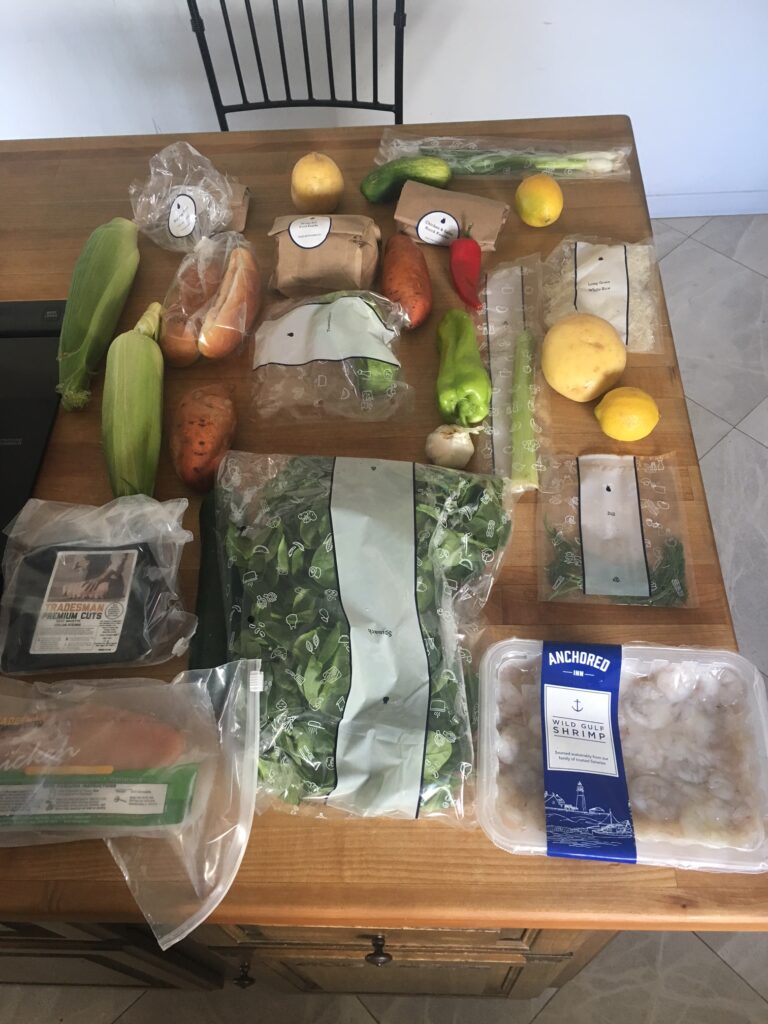
Quick answer: Treat “serves four” as a recipe yield, not a promise that everyone will be satisfied. Before ordering, divide the main ingredient quantities by the listed servings, compare them with dinners your household already eats, and budget for any extra food. A nutrition-label serving is not a recommendation for how much someone should eat. (fda.gov)
A useful portion check starts with the recipe card—not the photograph or the words “family friendly.” Look at what arrives, what you must supply, and whether the people at your table will eat the main components.
This guide uses published U.S. provider information and recipe examples, not hands-on testing. Provider details were checked on October 10, 2026; recipes, ordering options and prices can change.
1. Count servings per dinner, not just meals per box
Write down two separate numbers:
- How many recipes are you ordering?
- How many servings does each recipe make?
Three recipes with four servings each provide 12 listed servings across three dinners. They do not provide 12 dinners for four people.
Also distinguish the subscription’s ordering size from your household size. Home Chef’s support pages list Family Plan meals in four-serving increments, with options for four, eight or 12 servings per meal. Its standard menu generally offers two, four, six or eight servings. HelloFresh’s U.S. information describes meal selections for two to six people. These are ordering formats, not guarantees about appetite. (support.homechef.com)
For a five-person household, that difference matters. Compare a six-serving option, where available, against a four-serving dinner with planned supplements. Do not assume every service offers the same sizes.
Check the weekly minimum too. Home Chef currently publishes a $90.81 minimum weekly order value for its Family Plan. A suitable four-serving recipe does not necessarily mean you can order only that dinner. Confirm the full checkout total and subscription requirements before committing. (support.homechef.com)
2. Translate the ingredient list into food on each plate
Use this basic calculation:
Total ingredient quantity ÷ listed recipe servings = quantity per equal share
Start with the components most likely to determine whether dinner works:
- Meat, fish, beans, tofu or another main protein
- Rice, pasta, potatoes, bread or tortillas
- Vegetables
- Sauces, cheese and toppings
Record whether quantities refer to raw, dry or already cooked ingredients. Do not compare cooked pasta ounces directly with dry pasta ounces. If the recipe does not make the ingredient’s state clear, flag the comparison as uncertain rather than guessing.
For individually portioned foods, count pieces as well as weight. Ask whether the stated yield means one burger each, several tacos each or a share of a casserole. Then compare that structure with a familiar dinner.
A practical worksheet might look like this:
| What to record | Why it helps |
|---|---|
| Selected serving setting | Prevents using a two-serving ingredient list for a four-serving order |
| Total main ingredient quantities | Shows what must be shared |
| Raw, dry or cooked status | Keeps comparisons meaningful |
| Included side dishes | Identifies what is missing from your usual dinner |
| Pantry ingredients you supply | Captures extra purchases and preparation |
| Pieces or portions per person | Makes burgers, tacos and similar meals easier to assess |
Avoid predicting final cooked weight unless the provider supplies it. Compare the recipe’s quantities with your own shopping or cooking notes using the same ingredient state.

3. Compare two published four-serving dinners
These Home Chef recipes illustrate why the same serving count can describe different dinners. They are published examples, not confirmation that either recipe is available in your next delivery.
| Published recipe | Key quantities for four servings | Equal-share calculation | Published nutrition per serving | Listed prep and cook time |
|---|---|---|---|---|
| Teriyaki Chicken with rice and broccoli | 20 oz chicken; 12 oz broccoli; 5.76 oz Minute Rice | 5 oz chicken; 3 oz broccoli; 1.44 oz rice before preparation | 460 calories; 36 g protein; 1,540 mg sodium | 25–35 minutes |
| Two-Cheese Chicken Penne | 20 oz chicken; 16 oz cooked penne; 2 oz spinach, plus sauces and cheese | 5 oz chicken; 4 oz cooked penne; 0.5 oz spinach | 490 calories; 41 g protein; 1,280 mg sodium | 45–55 minutes |
Quantities, nutrition and timings come from the official recipe pages; equal shares are calculated by dividing by four. (homechef.com)
The useful question is not “Which looks larger?” It is “Which resembles a dinner our household eats comfortably?”
If your usual chicken-and-rice dinner uses more vegetables, plan that difference before ordering. If your household expects pasta alongside a substantial separate vegetable dish, check whether the included spinach matches that expectation.
Neither example establishes a universal portion standard. Keep the original ingredient totals in your notes so you can compare another recipe without relying on a general impression of the brand.
4. Use nutrition as a comparison tool, not an appetite guarantee
Check whether nutrition is listed per serving or per package. The FDA explains that Nutrition Facts information is usually based on one serving, although some labels also show the whole package. Eating two servings means consuming twice the listed calories and nutrients. (fda.gov)
For meal-kit planning, review calories alongside protein, fiber where reported, sodium and the actual ingredient list. Ask:
- Does this resemble the dinners that usually work for us?
- Does the nutrition describe the selected recipe version?
- Have we included the sides we intend to serve?
- Would unequal portions make the per-serving figures misleading?
If one person takes substantially more chicken while another takes mostly rice, do not assume each plate has the recipe’s listed nutrition.
There is no single calorie number that proves a meal will satisfy every adult, child or teenager. NIDDK distinguishes a portion—the amount someone eats—from a labeled serving, and notes that energy needs depend on factors including age, body size and activity. (niddk.nih.gov)
Use recent household meals as your benchmark rather than assigning fixed “child portions” or “teen portions.” If someone has prescribed dietary requirements, check suitability separately; a family-menu label does not establish it.
5. Plan differently for younger children and teenagers
Consider two hypothetical four-person households evaluating the same dinner.
Two adults and two younger children: Suppose recent dinners suggest the children prefer smaller initial helpings, with more available if wanted. A four-serving kit may be a sensible trial—but do not count on leftovers before seeing what everyone eats. Consider whether sauces or toppings can remain separate where the recipe allows.
Two adults and two teenagers: Suppose all four usually eat full plates and someone often wants seconds. Compare the kit’s total quantities with that familiar dinner. If there is a recurring shortfall, price a larger order or an intentional side rather than hoping four listed servings will stretch.
Age alone does not determine the right order. Base these choices on the household’s observed eating patterns, not assumed fractions of an adult serving.
For each household, identify the possible mismatch:
| Possible mismatch | What to compare before ordering |
|---|---|
| Main dish is eaten, but more food is usually wanted | Larger serving option versus kit plus side |
| Included vegetable is routinely left uneaten | Another recipe versus a replacement side |
| Main protein quantity seems too small | A larger order or suitable additional protein |
| Flavors do not suit part of the household | Another menu choice or separable components |
| Dinner fits, but planned lunch leftovers disappear | Additional servings specifically for lunches |
Choose an addition that addresses the actual gap. Extra rice does not solve a missing main-protein portion, and extra broccoli does not solve a recipe nobody wants to eat.
6. Calculate the full cost and extra preparation
Compare complete household dinners, not advertised per-serving prices.
For budgeting, use:
Dinner cost = recipe charge + allocated delivery cost + extras + supplemental groceries + applicable taxes
When a box contains several dinners, dividing the delivery charge equally among them is a simple budgeting method. State that assumption; it is not a provider’s recipe price.
Here is a worked example using illustrative inputs, not current provider or grocery prices:
- Four-serving recipe charge: $32
- Share of box delivery cost: $4
- Base dinner total: $36
| Hypothetical dinner plan | Supplemental food cost | Total dinner cost | Average across four diners |
|---|---|---|---|
| Kit alone | $0 | $36 | $9 |
| Kit plus a vegetable side | $3 | $39 | $9.75 |
| Kit plus extra rice and vegetables | $5 | $41 | $10.25 |
These figures exclude taxes, pantry ingredients and any additional kit charges. Replace every input with your checkout total and local grocery costs. The averages are budget calculations—not proof that each person receives an adequate portion.
Track preparation separately:
- Hands-on work: washing, chopping, measuring and serving
- Elapsed time: when everything is ready to eat
- Cleanup: additional pans, bowls and utensils
For illustration, if a side needs five minutes of hands-on work and 10 minutes to cook, making it during the main recipe may avoid adding 10 minutes to dinner’s finish time. Making it afterward may not. That is scheduling arithmetic, not a tested timing claim.
Follow the side’s own instructions. Do not simply add extra rice, chicken or vegetables to the kit’s trays without adjusting quantities and following an appropriate cooking method.
7. Run a small trial and check the common mistakes
Before choosing the largest recurring order, try a manageable selection of recipes your household is likely to eat, subject to the service’s minimum.
After each dinner, record:
- Whether anyone wanted more food
- Which components ran out first
- Which components were left
- What supplemental food you used
- The complete cost
- Actual hands-on and elapsed time
Separate “not enough food” from “enough food, but not food people wanted.” Those problems call for different changes.
Watch for these common mistakes:
- Judging by photographs: use the ingredient list and yield instead.
- Missing the serving selector: verify quantities for your intended order size.
- Comparing unlike weights: keep raw, dry and cooked quantities distinct.
- Assuming leftovers: count next-day lunches as additional demand.
- Ignoring recurring extras: include replacement vegetables, sides and pantry purchases.
- Treating family-friendly as allergy-safe: check the recipe and delivered labels. Home Chef’s example recipe pages state that its facility is not certified allergen-free and that ingredient information can vary. (homechef.com)
- Using an archive recipe as a current menu promise: confirm availability before paying.
Final ordering check: Can you identify the yield, main ingredient quantities, likely household fit, planned supplements and complete weekly charge? If not, pause and resolve the missing information.
The goal is not to prove that a brand has universally generous portions. It is to find an ordering pattern that feeds your household without repeatedly adding unexpected groceries or cooking a second dinner.